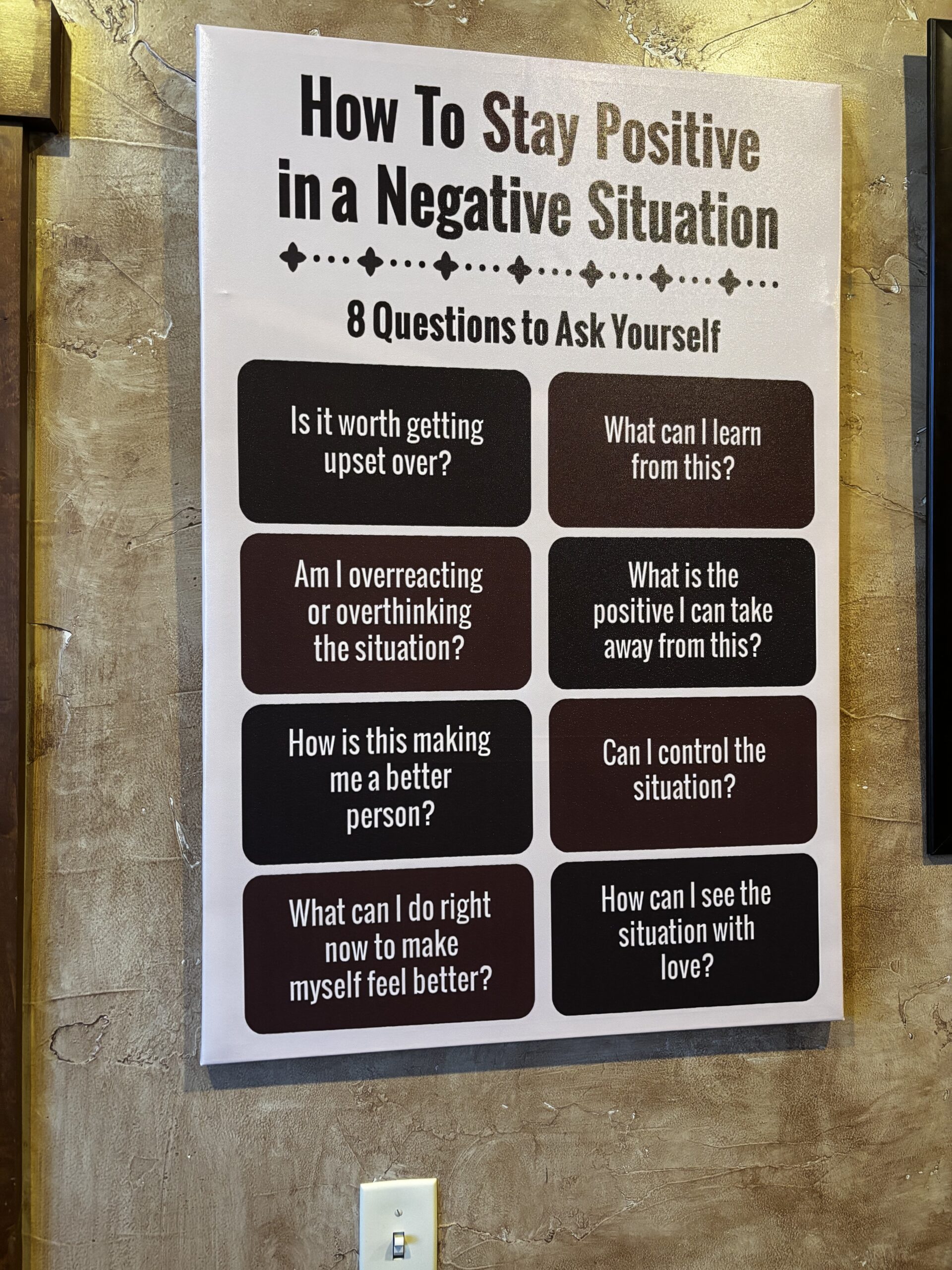
How to Stay Positive in a Negative Situation
Introduction
A friend gave me the wall hanging pictured above, and I placed it outside my office door because it seemed fitting for the setting. At first, I regarded it as a pleasant collection of fairly concrete reminders—useful, perhaps, but nothing especially profound. Yet I have been surprised by the attention it has drawn. Many people have stopped to read it, taken pictures to review later, commented on one of more of the questions during their session, or contemplated the concepts while waiting for the session to begin. Clearly, something about these eight questions has resonated with people. Thus, I thought I would present them here with a little elaboration, in hopes that their usefulness might reach beyond the wall outside my office.
Is it Worth Getting Upset Over?
We typically decide whether something was worth it by asking whether what was gained justified the price. So what is actually gained by getting upset? Do we gain even more by getting really angry? Feeling upset is often the inevitable first reaction when something goes wrong. Yet no matter how ticked we get, it changes nothing about what happened or how unfair it may be. The sooner we channel our energy toward a solution, the better off we are. It is understandable—perhaps unavoidable—to initially feel upset. Beyond that first reaction, however, it becomes a drain on mental and emotional energy that would be better directed toward considering what needs to be done next. The bigger the problem, the more we need our available bandwidth for clear thinking, sound judgment, and effective action. Prolonged anger drains energy and concentration as we keep replaying the situation and get ourselves worked up, depleting ourselves without changing a thing. Asking whether something is worth getting upset over means recognizing that emotional upset is mainly useful for alerting us that something needs our attention. Beyond that, it serves no purpose. So perhaps the answer is that nothing is worth getting overly upset over, since doing so usually makes the problem worse. Beyond the initial jolt, continued anger and upset at best get in the way and at worst become problems of their own. A wise response to a problem does not begin by making the problem worse.
Am I Overreacting or Overthinking the Situation?
Our first reaction is usually more emotional than accurate. When we feel threatened, rejected, criticized, embarrassed, uncomfortable, or insecure, we can quickly move beyond what actually happened and begin fabricating explanations, predictions, blame, motives and worst-case scenarios. A delayed response to our text becomes evidence that someone is angry or ghosting us. One mistake becomes yet another proof of our incompetence. A bad day becomes a sign that we are backsliding and that all the progress we thought we had made is unraveling. Thinking involves considering the options available to us and deciding which one is best. Overthinking is something entirely different. Rather than weighing our options in pursuit of a solution, our mind slides into “what if this happens?” Or “what if they mean that?”—spinning from one awful possibility to another. Our thinking becomes increasingly detached from the facts, and our emotional reaction intensifies along with it. If we are not considering options and are instead inventing imaginary scenarios, then we are overthinking. And when our mind turns a molehill into a mountain—or at least spends no time planning how to scale the mountain—we are likely to overreact as well. It is useful to pause and separate the facts from the narrative we are creating about them. Overreaction magnifies the emotional meaning we assign to an event. Overthinking keeps us spinning on it long after useful reflection should have ended. If our thinking is not helping us resolve the issue and is instead only amping us up, then we are thinking about the problem beyond the point of usefulness—which is not the purpose of thinking.
How is This Making Me a Better Person?
We do not need to believe that everything happens for a reason in order to recognize that hardship can shape us for the better. It is often through our difficulties that we develop greater patience, humility, courage, compassion, self-awareness, or clarity about what matters most. Hardship may expose a weakness we need to address, a boundary we need to establish, or a priority we need to set. Suffering does not automatically improve anyone. In fact, it can easily embitter, frighten, disillusion or exhaust us. Growth largely depends on what we decide to do with the experience. A growth mentality is oriented to becoming a little better with each passing day, which can accumulate into significant maturation over the course of a year. Within this mentality, every situation—good or bad, easy or difficult—becomes the life context in which today’s growth can occur. Situations in and of themselves do not naturally make us better. We must deliberately ask how each one can make us better. Doing so shifts our attention from what has been taken from us to what may be developing within us. The question is not intended to make pain pleasant, but to see whether it can be converted into growing pains.
What can I Do to Make Myself Feel Better?
Problems have a way of sucking us into their vortex until we lose track of how we are feeling, the toll they are taking on us, and even our basic self-care. Self-neglect can slip in, almost unnoticed. We stop paying attention to whether we are sleeping well, eating enough, spending time with others, keeping up with responsibilities, or making room for fun and enjoyment. Even survival-level self-care can escape us unless we deliberately keep it in mind. When distressed, we may passively wait it out, hoping our emotional state will eventually change. Or we may become so consumed by the problem that we lose awareness of how we are doing, how we are feeling, and how poorly we may be taking care of ourselves. Even when—especially when—we cannot immediately solve the problem, we can almost certainly do something to make the present moment more manageable, more tolerable, or perhaps even enjoyable. We might take a walk, call a friend, eat some comfort food, take a nap, meditate or pray, write creatively or journal, listen to music, clock out and relax, or complete one small task that restores a sense of movement. Feeling better is a different task from fixing everything. It’s also a task typically within our capacity, and often one that only we can do for ourselves. There is great value in settling our souls so we can think more clearly, respond more effectively, and not wear ourselves out before the situation itself improves. The most useful question may not be, “How do I make this disappear?” but, “What kind and constructive thing can I do for myself right now to help me through until the storm finally passes?”
What Can I Learn from This?
A difficult experience can leave us hurt and diminished, or it can leave us wiser. The difference may depend on our decision to learn from it rather than merely lament that it happened. It may teach us something about another person, our own patterns, what we can tolerate, what skills we lacked, or what we need to do differently next time. Perhaps we ignored warning signs, expected too much, communicated poorly, acted impulsively, or trusted someone who had not earned it—or ultimately did not deserve it. Perhaps we handled the situation well and discovered that we are more capable than we assumed. Often, our list of the worst things we have ever been through overlaps considerably with the periods of life in which we grew the most. This can become a mentality of giving life our fullest shot, knowing that we will either succeed or learn from the experience how to become more likely to succeed the next time around. Learning does not require—or necessarily even involve—blaming ourselves for what went wrong. We can be treated unfairly and still ask what the experience revealed. We can fail miserably and still examine the many factors that contributed to the collapse. The goal is to become better through experience, wiser about the experiences we enter, and more capable of getting back on our feet to try again. Whatever happens, we can—and perhaps should— emerge with greater wisdom than we had before.
What is the Positive I can Take Away from This?
Looking for something positive is not the same as declaring the entire experience positive. Plenty of experiences are painful, unjust, or deeply unwanted. Forced optimism is dishonest and can come across as Pollyanna. We do not prepare ourselves for life by viewing it through rose-colored glasses. Still, in the aftermath of any negative event, there may be something worth carrying forward: greater appreciation for the people who remained, gratitude for the life, time, and relationships we still have; relief at having discovered the truth; the freedom to leave an unhealthy situation; or renewed appreciation for what we had previously taken for granted. Sometimes the positive is not found in the event itself, but in our response to it or in the change in perspective that follows. Perhaps we behaved with integrity, survived something we once thought would break us, asked for help and discovered that people were willing to offer it, or learned where our limits truly are. Finding something useful that came from the experience does not cancel out what it cost us, but it does mean we made an effort to carry something forward besides the pain.
Can I Control the Situation?
An alternate question many people ask is whether they even want to have to be in control—or responsible—for the situation. Being in control is often overrated as one of life’s great pleasures and is frequently more illusion than reality. We can try to influence, persuade, or manipulate things to go a certain way, but we actually have little direct control over most of what happens. A great deal of emotional suffering comes from trying to control what is not ours to control: another person’s choices, the past, an uncertain outcome, an illness, a delay, or what others think or say about us. This question invites us to draw an important distinction. If the situation is within our control, the next step is to take appropriate action. We can make the call, apologize, prepare, speak honestly, leave, persist, or change course. If it is outside our control, denying that reality causes additional and unnecessary suffering without altering the outcome at all. The Serenity Prayer invites us to accept the things we cannot change, which usually means nearly everything outside our own skin. Acceptance does not mean we like, approve of, or feel indifferent toward what is happening. It means recognizing reality for what it is and investing our energy where it can still make a difference. While we may have little control over the situation itself, we can always assume responsibility for our own conduct, intentions, words, and reactions. That is where our desire for control is best directed—and where the energy we expend is least likely to be regretted.
How Can I See the Situation with Love?
Love is relatively easy when we feel safe, understood, cared for, and treated well. Its real test comes when we have been hurt, betrayed, used, or mistreated. Seeing the situation with love does not require excusing harmful behavior, surrendering our boundaries, or forcing ourselves to cast harmful conduct in a kind light. Sometimes in life we need to confront, be firm, distance ourselves, refuse, or leave. But even then, we can do so as kindly and non-harmfully as the situation allows, determined not to add any more pain than the situation already contains. That, too, qualifies as seeing the situation with love—even in the toughest circumstances. It may mean trying to understand another person’s fear or limitations without denying the impact of what they did. Seeing the situation with love also extends to ourselves, offering us the same patience and compassion we would give someone we care about if they were in the same position. At times, it may mean leaving a relationship without hatred, telling the truth without cruelty, or refusing to reduce another human being to the worst thing they have done. Love is sufficient when our intent is not to cause additional harm or wish harm on anyone, while remaining wise enough to recognize that some pain and consequence will naturally follow certain choices. We do not need to become the cherry on top of another person’s consequences, nor should we take pleasure in anyone’s suffering—even when some degree of corrective pain may be deserved.